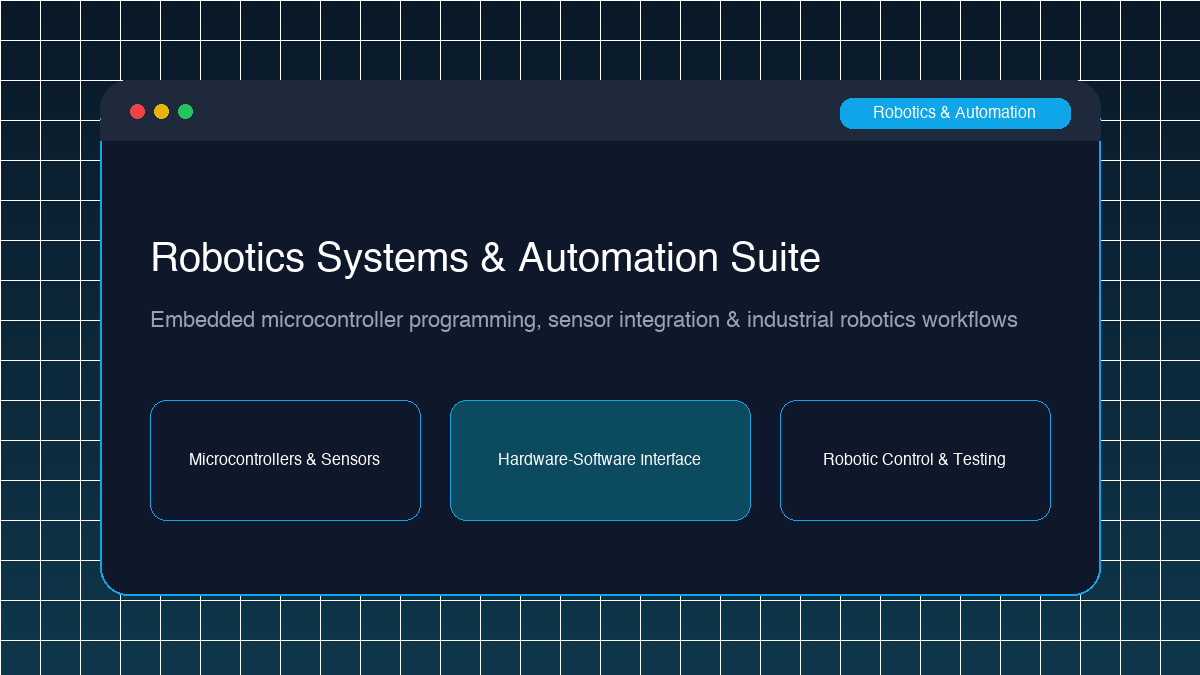
Robotum Robotics Systems & Automation Suite
Embedded robotics implementations, hardware-software control integration, sensor calibration, and industrial automation routines.
Timeline
2024 – 2025
Role
Robotics Engineering Technologist
Team
Robotum Bilişim Engineering Team
Status
CompletedTechnology Stack
Key Challenges
- Real-time Hardware Synchronization
- Sensor Noise Filtering
- Hardware-Software Communication Latency
- Physical Fail-Safe Mechanisms
- Field Deployment Environment Anomalies
Key Learnings
- Embedded Control Systems
- Asynchronous Microcontroller Communication
- Digital Signal Filtering Algorithms
- Industrial Diagnostic Routines
- Rigorous Hardware Safety Protocols
Robotum Robotics Systems & Automation Suite
Overview
During 2024 – 2025, I served as a Robotics Engineering Technologist at Robotum Bilişim Company in Ankara, Turkey. The company develops cutting-edge educational, industrial, and specialized robotics platforms.
My role focused on developing the technical systems, embedded communication bridges, and software modules that allow high-level software controllers to seamlessly operate physical actuators, sensors, and robotic sub-assemblies.
Technical Scope & Architecture
Modern robotics systems operate at the critical intersection of physical mechanics and software logic. Our technical stack was architected into clear functional tiers:
+-----------------------------------------------------------+
|              High-Level Software & Dashboard              |
|   - Telemetry Visualizer & Web Interface (TypeScript/Node)|
|   - Parameter Tuning & Mission Planning                   |
+-----------------------------------------------------------+
                             |
                             v  (Serial / WebSocket / CAN)
+-----------------------------------------------------------+
|           System Logic & Control Scripts (Python)         |
|   - Path Calculation & State Management                   |
|   - Sensor Calibration & Moving-Average Filtering         |
|   - Emergency Override & Watchdog Supervisor              |
+-----------------------------------------------------------+
                             |
                             v  (GPIO / I2C / SPI)
+-----------------------------------------------------------+
|        Microcontroller & Edge Hardware (C++ / RTOS)       |
|   - Motor Drivers, Encoders & Actuators                   |
|   - Ultrasonic, Infrared, & IMU Sensor Arrays             |
|   - Power Regulation & Hardware Cutoff Relays             |
+-----------------------------------------------------------+
Key Engineering Contributions
1. Hardware-Software Interface Development
- Engineered Python and Node.js serial communication bridges that read continuous sensory streams from microcontrollers at sub-10ms intervals.
- Established packet validation with checksums to detect and reject corrupted sensor data caused by electromagnetic interference.
2. Sensor Integration & Noise Suppression
- Configured array integration for inertial measurement units (IMUs), ultrasonic distance sensors, and rotary optical encoders.
- Implemented software digital filtering algorithms (moving averages and low-pass filters) to ensure smooth actuator reactions rather than erratic jitters.
3. Safety Routines & Physical Fail-Safes
- Programmed automatic watchdog routines that halt motor movement whenever ping latency exceeds safety thresholds or anomalous obstacle readings occur.
- Developed physical limit-switch overrides to prevent mechanical hardware binding.
Testing & Field Deployment
- Laboratory Bench Tests: Executed stress tests running robotic routines for dozens of continuous operational cycles, logging thermal and current draw metrics.
- Diagnostics Dashboard: Built a lightweight web interface for technicians to visualize real-time sensor readouts, calibrate zero-points, and trigger test sequences without opening raw terminal shells.
- Technical Documentation: Authored operational schematics and troubleshooting guides for onboarding technicians.
Impact & Key Takeaways
Working on the Robotum Robotics Systems & Automation Suite provided invaluable hands-on insight into physical computing:
- Resilience Under Constraint: Understanding how physical wear, voltage fluctuations, and mechanical tolerances influence software assumptions.
- Broadened Engineering Perspective: Bridged classical Computer Engineering software principles with real-world mechatronics.